
Is Your Business Invisible to AI? What Indian Business Owners Must Know About GEO in 2026
SEARCH
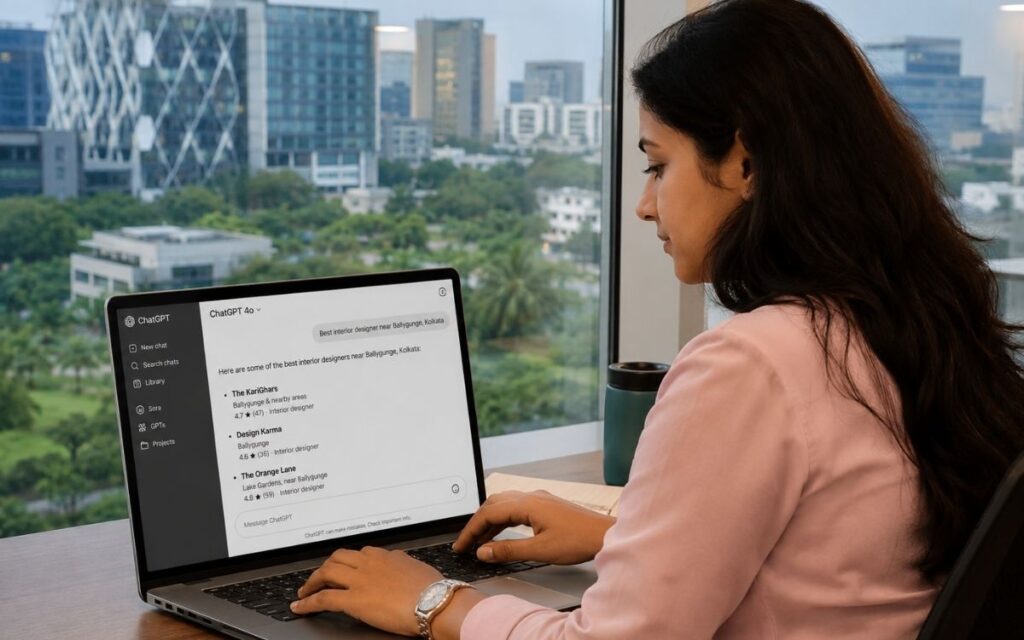
A potential customer opens ChatGPT or Gemini and types: “Best interior designer in Salt Lake” or “Reliable CA firm for GST filing in Andheri” or “Top Chinese Restaurant in Connaught place.” An answer comes back. It names two or three businesses confidently. Yours is not one of them. That customer never visits your website. They never see your Google My Business listing. They just call whoever the AI recommended. This is happening right now, across every industry, every single day.
The Way Customers Find Businesses Has Quietly Changed
Not long ago, the customer journey looked predictable. Someone needed a service, typed a query into Google, scanned the top results, checked a few websites, and made a call. Businesses competed for those top positions. SEO was the game, and most Indian businesses understood it well enough to play.
That journey is changing faster than most business owners have had time to notice.
India now has over 900 million internet users. A fast-growing share of them, particularly urban professionals, young buyers, and smartphone-first users, are skipping the search results page entirely. They open ChatGPT, Gemini, Perplexity, or Google AI Overviews, ask a direct question, and act on whatever answer comes back. No scrolling. No comparing links. No visiting three websites before deciding. Just a recommendation, and a decision.
Trust and reputation have always driven business referrals; this shift carries real weight. AI is becoming the new word-of-mouth. The businesses appearing in those AI-generated answers are winning customers silently. The ones that don’t appear are losing them just as silently.
So What Exactly Is GEO?
Generative Engine Optimization, or GEO, is the practice of structuring your website and content so that AI-powered platforms cite or recommend your business when answering user queries.
Traditional SEO was about ranking in Google’s list of blue links. GEO is about earning a mention inside the AI’s actual answer. The difference sounds technical. The business impact is very straightforward.
When someone asks an AI engine for a recommendation, it doesn’t return a browsable list. It generates one synthesized answer and pulls from a small handful of sources it considers authoritative. If your business is not structured to be one of those sources, you don’t appear. Not on page two. Not in a smaller font. Simply not at all.
The term GEO was formalized in research by Princeton University, Georgia Tech, and IIT Delhi, which gives it more grounding than most marketing buzzwords tend to carry. By 2025, it was a framework. By mid-2026, it has become a genuine business priority for any brand that depends on being discovered online.
Why This Hits Harder Than Most Business Owners Realize
Consider a few everyday scenarios playing out right now across Indian cities.
A young couple in Ballygunge, Kolkata, is renovating their first apartment. They ask Gemini: “Best modular kitchen brands in Kolkata.” Gemini names three. Their shortlisting begins and ends there.
A startup founder in Andheri needs a branding agency for a product launch. She asks ChatGPT for recommendations. Two agency names come up. She books a discovery call with both of them that same evening.
A senior HR manager in Gurugram asks Perplexity: “Which corporate training companies in Delhi NCR are good for leadership programs?” Perplexity cites two firms with brief explanations of why. The HR manager forwards those names to the leadership team.
In none of these cases does the customer visit a search results page. They never get to page one of Google. The businesses that spent years optimizing for that page one position are invisible to these buyers.
This is the quiet disruption that GEO addresses. And according to a Digital Marketing Trends, more than half of marketers are already using AI to automate and accelerate their workflows, while search itself is moving from keywords to AI-led answers. The infrastructure shift is already underway.
How GEO Is Different from SEO, and Why You Still Need Both
Dropping SEO in favor of GEO would be a mistake, and we say this from experience working with clients across industries. The two work together, not against each other.
SEO builds the technical foundation: site speed, mobile optimization, backlinks, crawlability.AI platforms still use search engine infrastructure to crawl and index pages. A slow, poorly built website will not perform in AI results any more than it performs in organic rankings.
Where they diverge is at the content strategy level.
SEO asks: how do I rank for this keyword?
GEO asks: when a potential customer asks AI about my category, does my business get mentioned?
Both questions matter. We have seen clients with strong SEO foundations pick up GEO traction significantly faster than those starting from scratch, simply because the technical groundwork is already solid. If you have invested in SEO over the past few years, you are not starting over. You are building the next layer on top of something that already works.
What AI Engines Actually Look for When Deciding What to Cite
This is the practical part. Understanding what earns citations helps you prioritize where to spend your content effort.
Direct, structured answers. AI systems scan content for passages that directly answer specific questions. Pages that hedge, ramble, or bury the answer below promotional copy tend to get skipped. Every service page on your website should answer a clear question in the first two to three sentences.
Topical depth and authority. A website that covers a subject comprehensively across multiple well-structured pages signals expertise to AI engines. A single shallow page on a broad topic does not. If you run a physiotherapy clinic in New Town, a website with five detailed pages covering different treatment approaches will consistently outperform a one-page brochure site in AI citations.
Schema markup. FAQ schema, HowTo schema, and Organization schema are particularly effective at getting your content parsed correctly by AI systems. This is technical work, but it is foundational to GEO performance.
EEAT signals. Google’s own Search Quality Evaluator Guidelines describe Experience, Expertise, Authoritativeness, and Trustworthiness as the core quality framework. AI citation engines apply similar logic. Content attributed to named professionals with verifiable credentials and real-world examples consistently outperforms generic brand-voice content.
Specificity to the Indian context. AI models reward specificity. A blog post titled “How to choose a digital marketing agency” will lose to one titled “What a mid-sized Bengali retail brand should look for in a digital marketing partner.” Local context, local examples, and local pricing references all strengthen your citation potential in Indian AI search.
Which Indian Businesses Need to Act on This Right Now
Industries like healthcare, real estate, legal, and finance are seeing strong AI search growth in India. But the list goes further than that.
Any business that depends on being discovered by new customers online needs to pay attention to GEO. That includes:
Medical clinics and diagnostic centers. When a patient in South Kolkata asks Gemini “best orthopedic clinic near me,” the AI pulls from structured, authoritative health content. Clinics with detailed service pages, doctor profiles, and FAQ sections are far more likely to appear than those with generic landing pages.
Restaurants and hospitality businesses. “Best rooftop restaurant in Park Street” or “authentic Bengali thali in Kolkata” are exactly the kinds of queries AI tools are answering daily. Restaurants with well-structured websites, specific menu descriptions, and consistent local citations across the web are the ones getting recommended.
Professional services: CA firms, law firms, consultancies. High-trust queries like “GST consultant in Kolkata for export business” or “family lawyer in South Delhi” are increasingly being answered by AI. These buyers are often making significant decisions. Being the cited authority in your niche carries enormous conversion value.
E-commerce and D2C brands. A survey of Indian D2C brands found that those utilizing AI-driven marketing flows saw meaningful increases in average order value while reducing ad spend. Visibility in AI search is part of that same ecosystem.
This applies directly to almost every business, whether it’s a B2B or B2C, service-based or product-based.
Practical Steps to Start Optimizing for GEO Today
None of this requires a complete overhaul of your existing website. It requires a deliberate shift in how your content is planned and structured.
Audit your content for answer clarity. Go through your key service pages. Does each page directly and clearly answer a specific question a potential client would ask? If the answer is buried or absent, that page is not working for GEO. We run this audit as the first step with every new client, and the gaps are almost always immediately visible.
Add FAQ sections to every service page. These map directly to conversational AI queries. Each FAQ should have a clean, direct answer in two to four sentences, not a promotional paragraph. FAQPage schema markup applied to these sections makes them even more parseable by AI engines.
Build genuine author authority. Add author bios with verifiable credentials to every article and blog post. Link to the author’s LinkedIn profile. AI systems consistently treat content from identifiable professionals more favorably than content published under a faceless brand name.
Create original, specific content. Original data, documented case studies with real numbers, and well-sourced comparisons are among the highest-leverage GEO investments. You don’t need to commission expensive research. A documented client result with specific figures and context is exactly the kind of original content AI engines prefer to cite.
Consider regional language content. With over 700 million smartphone users and multilingual audiences across India, Hindi and Bengali language content is increasingly being processed by AI systems. Competition for citations in regional languages is currently far lower than in English, which means the opportunity is proportionally larger for businesses willing to invest early.
How to Know If GEO Is Actually Working
This is where most teams get stuck, because GEO results don’t show up in a traditional rank tracker. You are measuring citation share across AI platforms, not keyword positions.
The practical starting point is manual testing. Run queries in ChatGPT, Perplexity, and Google AI Overviews that relate to your services and city. Note whether your business appears. Repeat the test monthly. We do this regularly for our own agency and for clients, and even simple manual checks surface patterns that are entirely invisible in conventional SEO reporting.
Dedicated GEO tracking tools are now emerging in the market, and the category will mature quickly. But you don’t need to wait for perfect tooling to start. What you need is to start building citation-worthy content now, because AI citation authority, much like domain authority, accumulates over time.
The Window Is Open Right Now, But Not Indefinitely
Most Indian SMEs are still behind the GEO curve, which is exactly why the opportunity is significant right now. The businesses that act in 2026 will build citation authority that compounds. The ones that wait will find the gap considerably harder to close.
Traditional SEO took years to build meaningful results. GEO can show traction faster, with well-structured content on an established domain often earning citations within four to eight weeks of implementation. But the competitive window for early movers is real, and it is narrowing.
If a potential customer is asking AI right now, “who should I hire for X in my city,” the only question that matters is whether your business has done the work to be the answer.
At B3NET, we have been helping Indian businesses build their digital presence since 1999. GEO is the most significant shift we have seen in how customers discover businesses online, and we are actively helping clients prepare for it. If you want to know whether your business currently appears in AI-generated answers for your category, get in touch with our team for an audit.

Prosenjit Banerjee
Prosenjit Banerjee is a digital marketing professional, traveler, and technology enthusiast with a background in both engineering and business. He holds a degree in Computer Science Engineering and an MBA in Marketing, bringing together technical expertise and strategic marketing insight.
With experience in SEO, content strategy, website optimization, and marketing automation, Prosenjit enjoys exploring the intersection of technology, business, and consumer behavior. Beyond his professional work, he is passionate about travel and often shares insights drawn from his personal experiences, research, and observations.
Whether writing about travel, digital marketing, technology, or business, his goal is to provide practical, informative, and easy-to-understand content that helps readers make better decisions and discover new perspectives.
Related Posts

Designing Websites for AI Crawlers Without Sacrificing Human UX
Your website used to have one audience: people. Today it has two — the humans who scroll, click, and buy,...
View Details
Leave a Reply